
Printed On: Sep 8, 2026 || Published On: Sep 8, 2026
Air Conditioning: Relief or Environmental Threat
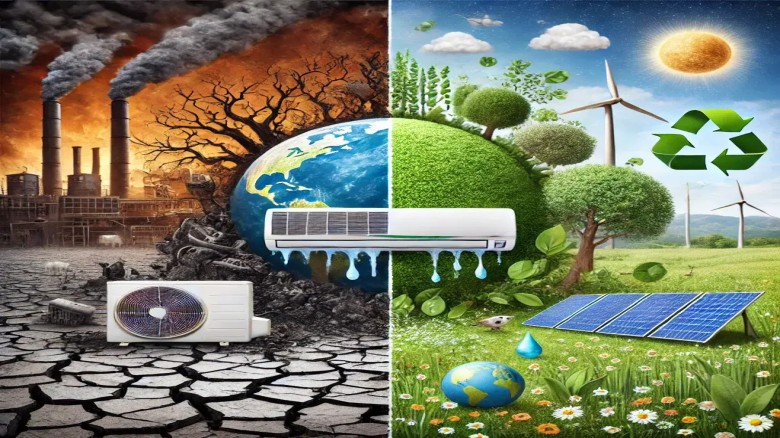
Global AC numbers could rise from 1.6 million to 5.6 million by 2050.
By 2050, the equivalent of nearly 10 new AC units being sold every second.
Electricity demand for cooling could more than triple by 2025.
Cooling emissions could rice from 4.1 to 7.2 gigatonnes.
HFC refrigerants are adding to climate risks.
Source: International Energy agency (IEA), United Nations Environment Program (UNEP)
Sakibul Hasan
As global temperatures rise, air conditioning use is increasing across the world. But could the Technology designed to keep people cool actually be making the planet hotter? Rising electricity demand, fossil fuel-based power generation and the release of powerful than greenhouse gases have made air conditioning an increasingly complex part of the climate crisis. As a global temperatures continue to rise, air conditioning is no longer simply a luxury. In many areas, it has become crucial for health and even survival. However, this growing dependence on air conditioning comes at an increasing environmental cost.
According to projections by the International Energy Agency (IEA), the number of air conditioners worldwide could increase from around 1.6 million today to approximately 5.6 billion by 250.
In other words, over the coming decades, the growth in demand would be equivalent to nearly 10 new AC units being sold every second.
The IEA warns that without rapid improvements in efficient and sustainable technologies, electricity demands for space cooling in buildings could more than triple by 2050. In many countries, a significant share of this additional electricity is still generated from fossil fuels. As more air conditioners are used, more electricity will be required, potentially driving up carbon emissions.
An energy expert said that 'The demand for cooling will continue to grow in the future. The major challenge now is how to meet this additional electricity demand with lower carbon emissions."
The environment impact of air conditioning is not limited to electricity consumption. Refrigerants used in air conditioners can become powerful greenhouse gas if they leak into the environment. Some hydrofluorocarbons, in particular, have the ability to trap significantly more heat than carbon dioxide.
According to the recent analysis by the United Nations Environment Programme (UNEP), cooling-related greenhouse gas emissions stood at approximately 4.1 gigatonnes of CO2 equivalent in 2022. If current trends continue, emissions could rise to around 7.2 gigatonnes of CO2 equivalent by 2050.
This creates a climate cycle:
A hotter planet → greater demand for AC → higher electricity use → increased greenhouse gas emissions → A hotter planet → even greater demand for AC.
Expert describe this situation as a "cooling paradox" On the one hand, cooling system are increasingly important for protectioning people from severe heat. On the other, insufficient and poorly planned cooling can further accelerate climate change.
A regular AC user said, during extreme heat, it is sometimes difficult to manage without air conditioning. Despite the higher electricity bills. it has become necessary for relief from intense heat.
Solutions, however, do exist. According to UNEP, wider adaptation of energy efficient cooling technologies, climate-friendly refrigerants, improved building design and renewable energy could significantly reduce future cooling-related emissions.
While air conditioner use continues to grow amid rising heat, concerns about its environmental impact arw also increasing. Manufacturers say newer generations of inverter and energy-efficient technologies consume comparatively less electricity, while the industry is also moving toward more environmentally friendly refrigerants.
According to experts, the question is no longer simply whether people should use air conditioners. The larger challenge is how to create cooling systems that protect people from extreme heat without making the planet even hotter.
An environmentlist said,"Stopping the use of air conditioning altogether is not a realistic solution. despite, its environmental impact must be reduced through energy-efficient technology, climate-friendly refrigerants, urban greening and heat-resilient building design."
In an era of intensifying heatwaves, air conditioning may represent relief and survival but if that relief comes at the cost of a warmer planet, the way the world keeps cool may need to be considered.
© 2025 Bangladesh Diary, All Rights Reserved
 Print
Print
 Save
Save