
Dhaka's Disappearing Birds Reflect a City Losing Its Biodiversity
Sakibul Hasan
There was a time when mornings in Dhaka began with the calls
of birds. Sparrows perched on house ledges, mynas sat on tree branches, crows
lined up on electric wires and a variety of birds could be seen among the trees
in parks. Which is familiar scene, however, is gradually changing.
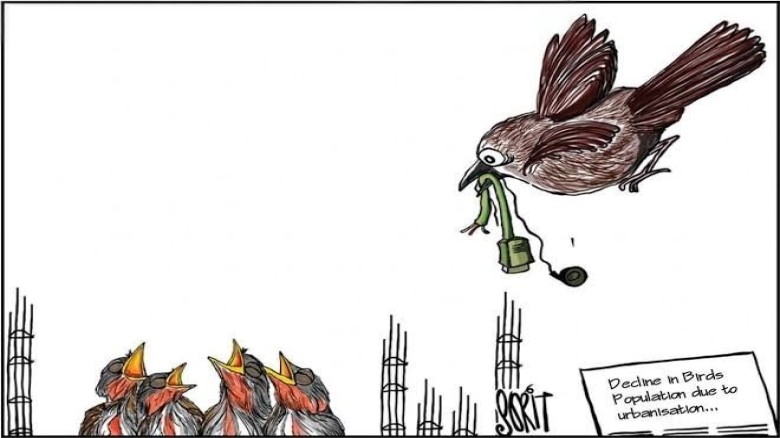
The expansion of concrete structures, rapid urbanization,
water bodies and worsening air pollution are increasingly shrinking the
habitats available to birds in the city. This changes are not merely a crisis
for one group of animals; it's also significant warning sign of growing
pressure on Dhaka's overall biodiversity and urban ecosystem.
A study published in the journal Ecology and Society in 2022
to identified 106 bird species in Dhaka city. Of these, 80 were residence
species, while 57 of the resident species where identified as potential
breeders within the city.
The study drew on existing records from 1995 to 2017, as
well as data from eBird and the Global Biodiversity Information Facility
(GBIF). In addition, researchers conducted field surveys at 190 sites across
Dhaka between February and June 2018.
During the field survey, researcher recorded 8,123
individual birds, representing 48 president species. Crows were the most
abundant according for 13.2% of the recorded birds, followed by sparrows at 13%
and mynas at 8%.
One of the most significant findings of the Dhaka study is
that birds are more abundant and diverse in green areas. Researchers found an
average of 12 bird species and 132 individual birds in green areas. In
contrast, more heavily built up areas had an average of only 6 species and 34
individual birds.
Concrete Expansion Is Reducing Diversity
Dhaka's rapid urbanization has transformed the city's
landscape over the first several decades. Natural and semi-natural areas have
increasingly been replaced by buildings, roads and other paved surfaces.
The Dhaka study found that an increase in impervious surface
- such as concrete and paved areas is associated with a decline in bird species
richness. Conversely, areas with getter habitat diversity and more green spaces
tend to support more birds.
Why Are Birds Declining?
There is no single reason behind the decline of suitable habitants for birds in Dhaka. Several factors are working together.
Loss of trees: large trees provide birds with nesting sites,
shelter and food. When mature trees are removed to make way for buildings and
roads, birds lose their habitat.
Loss of water bodies: Lake, ponds and other water bodies
provide food, breeding grounds and resting place of many species. Their
disappearance particularly threatens water dependent and wetland birds.
Expansion of concrete: The Dhaka study found a negative
relationship between the amount of impervious surface and bird species
richness.
Air pollution: A 2025 study covering five cities in
Bangladesh identified air pollution as an important factor associated with bird
diversity.
Noise pollution: Construction, traffic and continuous urban
noise can interfere with bird's communication and behaviour, making highly
disturbed areas less suitable for some species.
Pesticide and chemicals: Reducing insect populations can
also go down food availability for insect-eating birds. In the Dhaka study,
insectivore birds accounted for approximately 50 percent of the observed bird
community.
Unplanned urban development: When urban development focuses
primarily on buildings, roads and infrastructure while ignoring trees, water
bodies, parks and green corridors, pressure on biodiversity increases.
What Happened When Birds Disappeare?
Birds are an important part of the urban food web and
ecosystem. Some species help control insect population, other disperse seeds,
while scavenging birds help remove dead organic matter from the environment.
Therefore, a decline in bird diversity is not simply a problem for birds. It
can also signal broader changes in the urban ecosystem.
What Can Be Done?
Making Dhaka more bird friendly needs protecting the city's
remaining green spaces and wetlands. Mature trees should be preserved and local
trees species that provide food and shelter for birds should be prioritised in
urban planting programs. Park should not be accessively covered with concrete
while portions of shrubs, grassland and natural vegetation should be allowed to
remain. Water bodies also need stronger production. Simultaneously, the use of
pesticides in urban green spaces should be reduced wherever possible.
Another important step would be to conduct regular bird
censuses across Dhaka. Data collected year after year could reveal which
species are declining, which are increasing and how different forms of urban
development are affecting bird populations.
If the space for crows, sparrows and mynas continuous to
shrink, many more specialised bird species may eventually disappear from the
city and with them could disappeare parts of the trees, wetlands, insects, food
webs and ecological processes that make an urban environment truly alive. The
loss of birth from Dhaka, therefore, is not simply the loss of birds. It is the
loss of a living urban ecosystem.
© 2025 Bangladesh Diary, All Rights Reserved
 Print
Print
 Save
Save