
Every Picture Tells a Story: Bangladesh Through His Eyes
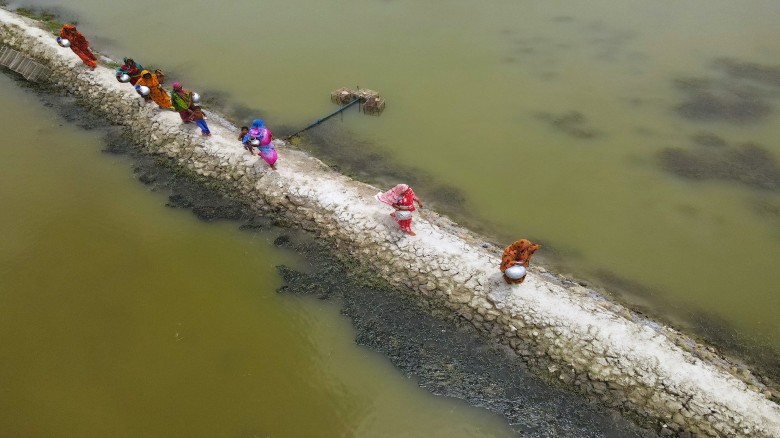
From a mischievous childhood in Mirsharai to international recognition, Muhammad Amdad Hossain has built his career documenting climate change, displacement, poverty and the resilience of people across Bangladesh. Interviewed by Sakibul Hasan
Growing up
in Mirsharai, Chattogram, Muhammad Amdad Hossain never imagined that the
landscapes surrounding his childhood home would eventually shape the way he saw
the world. As a child, he describes himself as mischievous and not particularly
disciplined as a student. He often skipped school to spend time outside with
friends. On one such occasion, a road accident left him seriously frightened
and nearly injured his face.

Yet his
childhood was also surrounded by extraordinary natural beauty. Hills and
waterfalls stood behind his home, while rivers, lakes and the sea were not far
away. Living among these landscapes gradually made him curious about people,
places and the small changes taking place around him. That curiosity eventually
found an outlet through photography.
From a Mobile Phone to a Camera
Muhammad
Amdad first became interested in photography around 2015, initially using
nothing more than a mobile phone. He photographed people, everyday moments,
nature and places that caught his attention, without imagining that photography
would eventually become his profession. Posting those photographs in Facebook
photography groups became an important part of his early learning. Feedback
from other photographers encouraged him, while studying the work of more
experienced photographers taught him about composition, light and visual
storytelling.

In 2016, he
took a major step forward by buying his first DSLR, a Canon EOS 5D Mark II. He
could not afford it alone, so he relied on an NGO loan and savings from his
parents. For his family, it was a significant investment in something that was
still only a passion.For him, however, the camera represented more than
equipment. It was a sign that his family believed in something he cared deeply
about.
Learning Without a Classroom
He never
received formal photography training in the beginning. Instead, he learned through
observation, experimentation, online communities and constant practice. He
studied the work of experienced photographers, listened to feedback and
repeatedly went into the field to photograph real situations. Trial and error
became his classroom.
Later,
professional workshops and mentorships-including Counter Foto, the Foundry
Photojournalism Workshop organized by The VII Foundation and PhotoWings, and an
editorial mentorship with AFP-helped him develop further. But he says the
foundation of his photography remains simple: self-practice, observation and
the willingness to keep learning.
From Photography to Photojournalism
As his
photography developed, he became increasingly interested in the stories behind
the images rather than simply creating visually attractive photographs. He
began photographing people, everyday life and social issues around him.
Documentary work gradually became his focus, and competitions, publications and
international opportunities followed.
Photography eventually became his profession
He chose to
work as a freelancer because independence allows him to follow stories he
genuinely cares about. Climate change, water insecurity, environmental
pollution, displacement and the lives of vulnerable communities have become
recurring subjects in his work. For him, freelance photography is not simply
about choosing where to work. It is about having the freedom to spend time on
stories that might otherwise remain underreported.
Photographing People, Not Just
Problems
Growing up
in Bangladesh, he has witnessed how closely people's lives are connected to the
environment. Floods, pollution, salinity, water insecurity and displacement are
not abstract issues; they directly affect people's livelihoods, dignity and
futures. His approach is to look beyond statistics and document how people
experience these problems in their everyday lives.

He also
believes that a photographer has a responsibility to protect the dignity of the
people being photographed. “The dignity of the person always comes before the
photograph,” he says. He does not want to portray people simply as victims.
Instead, he tries to show their humanity, resilience and strength even in
difficult circumstances.
Recognition Beyond Borders
His
photographs have appeared in major international media, and he has received
more than 200 international awards. Yet one recognition stands out: the Marai
Photo Grant by Agence France-Presse (AFP). The grant provided him with a
camera, funding, prize money and professional mentorship, allowing him to
develop his long-term project The Wells Are Dry: Water Crisis in the Coastal
Belt.
The project
later received international attention and was published by around 40–45 media
outlets worldwide. For him, the significance lies not simply in the award but
in the opportunity it created to spend time developing an important story and
bring it to a global audience.
What Photography Can Change
He does not
believe a photograph can solve a social or environmental crisis by itself. But
he believes it can make people stop, look and ask questions. A powerful
photograph can make complex issues easier to understand by showing their human
consequences. Climate change, pollution, water insecurity and displacement
become more immediate when viewers can see the people living through them. “If
an image can create empathy and encourage people to understand an issue more
deeply,” he says, “I believe it has already made a contribution.”
Looking Beyond the Lens
His
ambitions now extend beyond individual photographs. He wants to develop his
documentary projects into exhibitions and photobooks, particularly his work on
climate change, water insecurity, environmental degradation and displacement.
He also
hopes to pursue higher advanced training in visual storytelling, strengthening
his skills in research, editing and long-form narrative. His long-term goal is
to continue documenting underreported stories from Bangladesh and take them to
wider international audiences through exhibitions, books and publications.

Bangladesh Beyond Disaster
Perhaps the
strongest message he wants to communicate through his photography is that
Bangladesh should not be seen only through the lens of poverty and disaster.
Behind every statistic about climate change, pollution or displacement is a
person with a family, dreams and hopes. His camera is an attempt to make those
human stories visible.
For Amdad,
photography is ultimately not just about taking pictures. It is about
observing, listening and preserving moments that might otherwise disappear. And
through those images, he hopes the world will see Bangladesh not only as a
country facing enormous challenges, but as a place filled with people whose
dignity, resilience and stories deserve to be seen.
© 2025 Bangladesh Diary, All Rights Reserved
 Print
Print
 Save
Save