
Printed On: Nov 17, 2026 || Published On: Nov 15, 2026
Kabir Ahmed Bhuiyan Seeks Balanced Development in Brahmanbaria
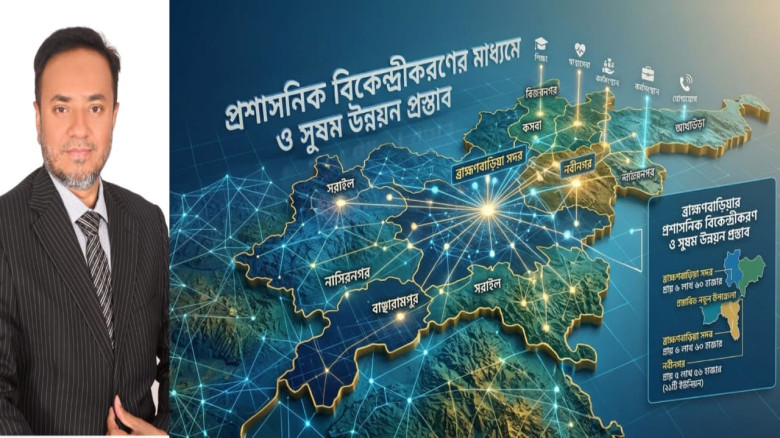
Sub-District Correspondent: Dulal Miah
Alhaj Kabir Ahmed Bhuiyan, a distinguished son of the district and a prominent businessman, has proposed administrative decentralisation and the formation of new upazilas for the balanced development of Brahmanbaria. He has said that the real development of a district is possible only when the people of every region of the district equally receive government services, development allocations, education, health, communication, employment and administrative facilities.
He said that development should not remain limited only to the construction of large infrastructures or government investment in specific areas. The main objective of development should be the improvement of the living standards of ordinary people and the creation of equal opportunities for every region. Article 59 of the Constitution of Bangladesh provides the constitutional basis for the local government system. One of the ways to make this system effective and strong is administrative decentralisation.
Kabir Ahmed Bhuiyan stated that the area of Brahmanbaria district is more than 1,927 square kilometres and the population is about 33 lakh. The district has 9 upazilas, 101 unions, 5 municipalities and 1,328 villages. The population density per square kilometre is 1,715. Administrative services for this district of nearly 33 lakh people are being managed through only 9 upazilas and 101 unions. Therefore, it is necessary to re-evaluate how far the administrative structure is consistent with the population and geographical reality.
Citing data from the Population Census 2022, he stated that the population of Brahmanbaria Sadar Upazila is about 6 lakh 60 thousand, Nabinagar 5 lakh 56 thousand, Sarail 3 lakh 64 thousand, Kasba 3 lakh 58 thousand, Nasirnagar 3 lakh 47 thousand, Bancharampur 3 lakh 35 thousand, Bijoynagar 2 lakh 90 thousand, Ashuganj 2 lakh 10 thousand and Akhaura 1 lakh 86 thousand. Nabinagar Upazila has 21 unions, which is the highest in the district. From this it is understood that the administrative needs of all upazilas are not the same.
He further stated that upazila reorganisation can be done as per necessity without changing the existing boundaries of the parliamentary constituencies of the National Parliament. The current structure of the six parliamentary seats of Brahmanbaria district is as follows — Brahmanbaria-1 constituency covers Nasirnagar; Brahmanbaria-2 covers Sarail, Ashuganj and Chandura and Budhanti of Bijoynagar; Brahmanbaria-3 covers Sadar and the remaining parts of Bijoynagar; Brahmanbaria-4 covers Akhaura and Kasba; Brahmanbaria-5 covers Nabinagar; and Brahmanbaria-6 covers Bancharampur. He believes that by keeping this structure intact, administrative services can be brought even closer to the people.
According to his proposal, as the first priority, Brahmanbaria Sadar Upazila, which has a population of about 6 lakh 60 thousand, can be divided into two parts. As the second priority, Nabinagar Upazila, which has 21 unions and a population of about 5 lakh 56 thousand, can be administratively reorganised. In addition, considering the importance of Akhaura land port, international rail connectivity and border trade, he also emphasised increasing the administrative capacity of Akhaura and Kasba upazilas.
He believes that if new upazilas are formed, positive changes will come in administrative services, health services, education, employment, communication and the local economy. Opportunities will be created for expansion of the Upazila Nirbahi Officer’s office, land administration, upazila health complex, new educational institutions, technical training centres, banks and financial services, development of small and medium industries, and marketing of agricultural and fisheries resources.
Kabir Ahmed Bhuiyan said that the development of a district should not be measured only by its total budget or large structures; rather, it should be measured on the basis of how easily an ordinary person in a remote village is getting medical treatment, how much educational opportunity a student is getting, how much government support a farmer is receiving, and how easily a citizen is getting administrative services.
He further said that development is not the exclusive right of any specific area. The right to development belongs to every person of Brahmanbaria. Taking the initiative to build a modern, prosperous and discrimination-free Brahmanbaria through administrative decentralisation, strong local government and balanced development is now the demand of the time.
© 2025 Bangladesh Diary, All Rights Reserved
 Print
 Save