
Water Congestion: The word Chatogram Chose Instead of a Solution
Rakib Hasan Alif
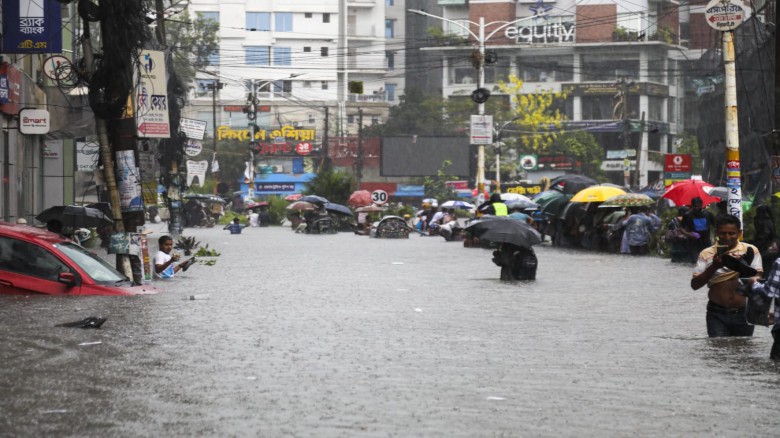
On the day parliament was told that Chattogram had no waterlogging, only what officials described as "water congestion" at five locations, the rain was still failing. Officials also dismissed reports of a submerged port city as imaginary and fabricated. By the next day, these three consecutive days of heavy downpour had once again left roads in Muradpur, Bahaddarhat, Chawkbazar, Katalgang, Agrabad, and Hamjarbagh under water. The city corporation's official Facebook page claimed there was "no significant waterlogging." The reaction in the comments told a different story. That captures the essence of Chattogram's monsoon crisis. Each downpour is followed by a familiar dispute over what the flooding should be called.
The pattern is not new. Over the past eight to ten years, roughly Tk 104 billion has been spent on drainage and canal projects that promised a permanent solution to Chattogram's flooding. One flagship project, originally scheduled to finish in three years, is now eleventh. Its second revision quietly removed elements such as silt traps and drain expansion to prevent costs from rising further. At the same time, responsibility remains fragmented. The Chattogram Development Authority, the City Corporation, the Bangladesh Water Development Board, and the Army's 34th engineer Construction Brigade all manage overlapping projects with separate timelines. When those efforts fall short, no single institution is left holding it.
For residents, the debate over terminology is almost irrelevant. What matters is the experience of living through the floods. A resident of Muradpur described wading through knee deep water to leave home on a Tuesday morning. The neighborhood, the resident said, floods every rainy season, yet the underlying problem remains unresolved. Others say, finding a rickshaw once the roads go under has become a matter of luck. And fears often double when people need transport the most.
Part of the answer is genuinely structural. During high tide, sea water in Chattogram can rise more than five meters above sea level. Gravity based drainage was therefore always going to face serious limits. The city has also lost nearly half of its canals, failing from about 104 to 57 because of encroachment and sedimentation. Only 36 are currently covered by active restoration projects. Engineers have also noted that a 1995 master plan calling for a city wide water retention ponds was never fully implemented. Nearly three decades later, the proposed solution remains largely on paper.
Infrastructure alone cannot explain why promised solutions continue to fall short. One major canal project reportedly began without adequate field surveys or hydrological studies. As a result, no physical construction could begin during its first eighteen months. The project timeline started long before the design was ready. This year's rainfall has also exceeded the assumptions behind existing plans. Data from the Bangladesh Meteorological Department shows that one recent storm brought 330.8 millimeters of rain is just 24 hours, including 60 millimeters within a three-hour period. Drainage systems engineered against yesterday's weather cannot be expected to hold against today's.
There is also a question, why are canals that have been built over so rarely reclaimed, even as new excavation projects are announced every few years? The public record suggests that enforcement exists but has often been selective and slow. A survey by the Chattogram Development Authority identified 1576 illegal structures on 123 acres of canal land across just 13 canals. In a separate case, the high court ordered the eviction of encroachers along the Karnaphuli river in 2016. Officials later identified 2,181 illegal structure on the river's north bank, yet only 350 were removed.
What stands out is not geography but preparedness. Many flood prone cities have improved response by investing in better information and faster decision rather than relying on infrastructure alone. Japan uses Digital twin technology to create virtual models of cities that simulate flooding before it occurs and provide early warning. South Korea combines underground stormwater storage with a shared platform that integrated weather, drainage, and transport data. Singapore uses real time sensors to adjust drainage capacity on conditions change, while Barcelona's pumping system activates automatically as water levels begin to rise. Chattogram doesn't need to recreate these systems exactly. It requires treating water the way a serious city treats traffic, watched continuously, shared publicly and act on immediately.
The writer is a student at the University of Chittagong
© 2025 Bangladesh Diary, All Rights Reserved
 Print
Print
 Save
Save