Princh Mondal Olif, Bagerhat District Correspondent
A new science-based initiative is opening up fresh possibilities for protecting Bangladesh's vulnerable coastal forests from river erosion and the destructive force of sea waves. Instead of relying solely on tree plantation, the initiative focuses on reducing wave energy and stabilising vulnerable coastal land before establishing or restoring forest cover.
Under the initiative, specially designed barriers are being installed along exposed coastal areas using locally available materials. The project is being implemented with financial and technical assistance from the Japan International Cooperation Agency (JICA).
Coastal forests play a vital role in protecting Bangladesh's environment, biodiversity and coastal communities. They serve as natural protective barriers against cyclones, storm surges, strong winds and powerful sea waves. These forests also provide essential habitats for numerous species of wildlife and aquatic organisms.
However, persistent erosion caused by rivers and the sea is threatening significant portions of coastal forestland every year. Strong waves gradually remove soil from exposed shorelines, leaving tree roots uncovered and weakening their ability to remain anchored. Eventually, trees may collapse, while portions of forestland disappear beneath river and sea waters.
The consequences extend far beyond the loss of trees. Forest degradation threatens wildlife habitats, ecological balance, natural resources and the livelihoods of coastal communities. It also weakens the natural protection that forests provide against extreme weather events.
Several factors contribute to coastal erosion, including strong sea waves, tidal currents, river flows, storm surges and high-velocity coastal winds. Climate change, rising sea levels and changes in coastal geomorphology are further intensifying these challenges.
As a result, conventional tree-planting programmes alone may not always deliver sustainable outcomes in highly erosion-prone areas. Stabilising the land and reducing the direct impact of waves have therefore become essential components of effective coastal forest management.
Reducing wave energy through locally available materials
The new initiative introduces specially designed barrier structures along exposed coastal sections where waves directly strike forestland. These structures are installed according to specific designs and plans, using locally available and comparatively low-cost materials.
With financial and technical support from JICA, the initiative aims to reduce the force of incoming waves before they reach vulnerable forest areas. The structures are designed not to completely block water movement but to dissipate wave energy in a controlled manner.
By reducing the intensity of water movement, the barriers are expected to help minimise soil erosion and create favourable conditions for sediment deposition. Gradual accumulation of silt and sediment may contribute to land stabilisation and create suitable conditions for future vegetation growth.
One of the key features of this approach is its reliance on indigenous materials rather than expensive and rigid concrete infrastructure. By working with natural coastal processes, the initiative seeks to establish a more environmentally compatible approach to shoreline protection and forest conservation.
A combination of technology and natural processes
The initiative represents an emerging approach to science-based coastal forest management, combining local resources, technical planning and environmental considerations.
Local community participation, scientific monitoring and the flexibility to modify structural designs according to site-specific conditions are important aspects of the approach.
Monitoring wave behaviour, water movement, sediment accumulation and changes in coastal landforms will be essential to assess the effectiveness of these structures over time. Such observations can also help determine which designs are most suitable for different coastal environments.
Protecting biodiversity and coastal livelihoods
If successfully implemented, the initiative could provide benefits extending well beyond forest conservation.
Healthy coastal forests provide habitats for birds, wildlife, reptiles, insects and various aquatic species. Reducing erosion and protecting forestland can help preserve these habitats, maintain natural food chains and support ecological balance.
Coastal forests also serve as natural protective barriers during cyclones and storm surges. Their continued existence can help reduce the impact of natural disasters on settlements, agricultural land, houses, infrastructure and the livelihoods of coastal communities.
Protecting forestland will also help safeguard public investment in coastal afforestation and environmental conservation.
Government commitment to environmental protection
Commenting on the initiative, the State Minister for the Ministry of Environment, Forest and Climate Change said that the present government is committed to protecting the environment and ecological systems.
He said environmental protection is a prerequisite for sustainable development. Increasing forest coverage and expanding tree-planting programmes are therefore essential.
The minister also emphasised that planting trees alone is not enough. Appropriate measures must be taken to ensure that newly planted trees survive and grow.
He added that special attention must be given to coastal areas, particularly along the seashore, so that planted trees are not destroyed by storms and storm surges. The government is taking necessary measures to address these challenges.
The long-term success of this indigenous technology-based initiative will depend on scientific monitoring, effective planning, community participation and adaptive management. If implemented and maintained properly, the approach could become a promising strategy for protecting coastal forests, preserving biodiversity and strengthening the natural resilience of vulnerable coastal communities in Bangladesh.
News Published By:
Bangladesh Diary

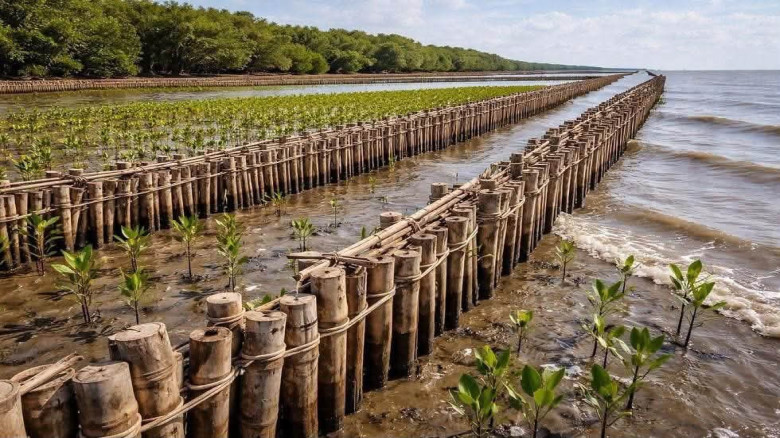 Photo: .