Dhaka

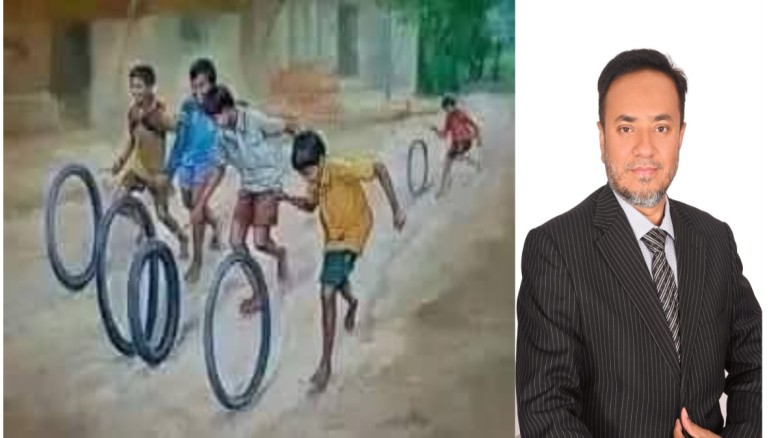 Photo: .

Kabir Ahmed Bhuiyan
First Part:
The Village Where I Left My Childhood—
There is a strange rule in human life. As age advances, the path moves further forward; yet the mind repeatedly wants to return to those days left behind. At the final edge of life, people search most for their childhood. Because childhood is the only time when there was no artificiality, no calculations—only pure joy and boundless love.
Even today, standing by the window on a quiet afternoon and looking at the distant sky, it feels as if my childhood is still left behind in that village. Perhaps it is calling me while standing in a sea of yellow mustard flowers, or sitting and waiting on a raw bamboo bridge, or my little shadow is still floating in the calm mirror-like waters of Boalia Beel and Dakshin Beel. Time has taken me far away, but my mind has never been able to leave that village.
It was the 1980s.
That small village of Barishal in Brahmanbaria district was like a peaceful paradise, isolated from the noise of the world. There was no glittering light of electricity, no busyness of paved roads, no arrogance of modern civilization. But what was there—today’s world has learned to understand its value—pure air, deep humanity, sincere relationships, and an inseparable bond between humans and nature.
Dawn broke with the chirping of birds and the crowing of roosters. As soon as the first light of the sun appeared in the eastern sky, countless dewdrops sparkled like pearls on the dew-soaked grass. When the white blanket of fog slowly lifted and the sunlight spread across the fields, it felt as if nature had decorated the world anew.
At that time, IRRI rice cultivation had not yet started in our area. With the change of seasons, the appearance of the fields also changed. When winter came, the endless yellow flowers of mustard seemed to paint the earth in golden color. Somewhere wheat ears swayed in the wind, somewhere jute plants stood tall, somewhere fields of black gram, ausli, and parsum rice stretched to the horizon.
Looking from a distance, it seemed as if the great Creator had painted an exquisitely beautiful picture with His own hand on a green canvas. That picture had no frame, no limit—only vast nature and endless beauty.
The monsoon was the most vibrant season of our village.
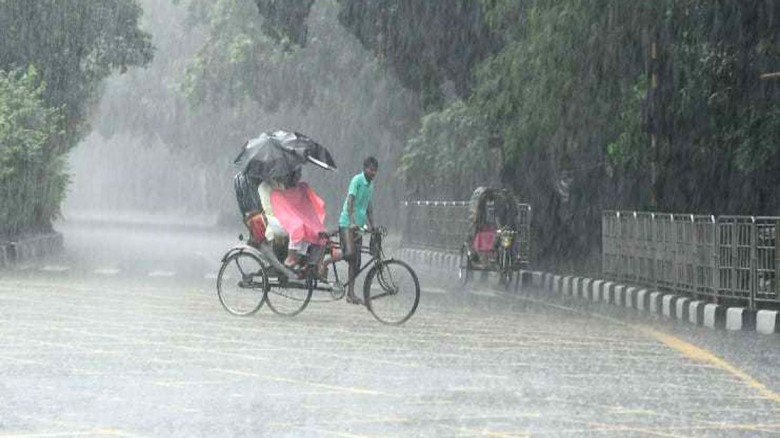
Black clouds filling the sky, drizzling rain, the smell of wet earth, and water everywhere—all together created a different world. When the rains came, large flocks of parrots would descend on the paddy fields. From a distance, it looked as if another layer of green had been spread over the green paddy.
There was anxiety in the eyes of the farmers then. Because these birds could damage a lot of the ripe paddy in moments. But for children like us, it was a festival of joy. We stood in wonder and just watched—how wonderful that scene was! It seemed as if nature itself had set up a colorful fair.
In the wheat season, the appearance of the fields would change again. With the coming and going of mynas, crows, and various other birds, the farmers would become busy. Some would drive the birds away by beating tin cans, some would tie cloth that fluttered in the wind, some would place scarecrows in the middle of the field, and some would shout in loud voices.
Today I think, back then these were ordinary scenes of life. Yet now I understand that those were living chapters of Bengal’s eternal agricultural life—which are gradually disappearing in the flow of time.
My elder uncle Abu Naser Bhuiyan, uncle Maju Bhuiyan, Dubraj Bhuiyan, Firoz Bhuiyan, Abdul Hasim Bhuiyan, Dhan Mia Bhuiyan, and many others were respected householders of the area. They had large herds of cattle. Alongside, they also raised sheep and goats. At that time, livestock were not just assets; they were as dear as family members.
As soon as dawn broke, the cowherds would start walking towards the fields with the cattle, carrying long sticks on their shoulders. The tinkling sound of the bells tied around the cows’ necks, the melodious calls of the cowherds, and the pure morning air—still ring in the ears today.
We also had a few cows at home. But more than the cows, I was attracted to the life of the cowherds.
After releasing the cows in the field, they would engage in stick fighting. How extraordinary was their skill! Hearing the sound of the stick cutting through the air as it spun, it felt as if some ancient martial technique of war had come alive before the eyes. Holding the cow’s rope in my hand, I would stand spellbound and watch. In my mind, I would dream—one day I too will learn to spin the stick like them.
Dakshin Beel and Boalia Beel on the eastern side of the village were the heartbeat of our village.
On one side, herds of cattle were grazing peacefully; on the other side, the cowherds’ stick fighting; a little further away, fishermen were casting nets. Somewhere a cormorant was diving, somewhere a white egret was standing on one leg, and again a flock of wild ducks was flying in the sky. The sound of waves, the calls of birds, the shouts of people—all together, nature composed a new symphony every day.
At that time, I did not understand that these scenes would one day become the most valuable assets of my life.
When the mustard flowers bloomed, bees would come to the village in swarms. They would fly around the tin houses. The elders of the house would tap the tin roofs with sticks. That metallic sound seemed to signal them to a safe shelter. Then a new hive would be built on some tree branch.
I would watch in wonder—how thousands of bees were building their new household with such perfect order. Today it seems that nature also has its own language, which requires not bookish knowledge to understand, but the power of feeling.
As the last light of the afternoon fell, the village fields would transform into the kingdom of children.
Golla chhut, dariyabandha, hadudu, danguli—the surroundings would become filled with the sound of laughter. Some were playing football, some were diving into the pond and swimming underwater. In the courtyards of the houses, girls were playing bou-chi, and mothers were managing the small tasks of the household while chatting.
When evening fell, the sweet call of the azan would float from the distant mosque. In a moment, the entire village would become quiet. The herds of cattle would return to the cowsheds, the light of the kupi (oil lamp) would light up in the courtyards, and hearing mother’s affectionate call, I would understand—another joyful day had come to an end.
Many years have passed now.
Much of that field may no longer exist. New structures have risen in place of the mustard flowers. The cowherds’ stick fighting has disappeared, and the flocks of parrots no longer descend as before. But time has not been able to touch the village inside the memory.
It is still as green as before, as pure as before, and as full of love as before.
I know that these memories are not just mine. Inside the hearts of countless people of my generation, such a village is still living silently. That is why I have taken up this pen. I want to write the stories of those lost golden days, so that the coming generation may know—once upon a time, a Bengali village was not just a geographical place; it was the safest shelter of the human heart, the purest address of love, and the most beautiful paradise named childhood.