Dhaka

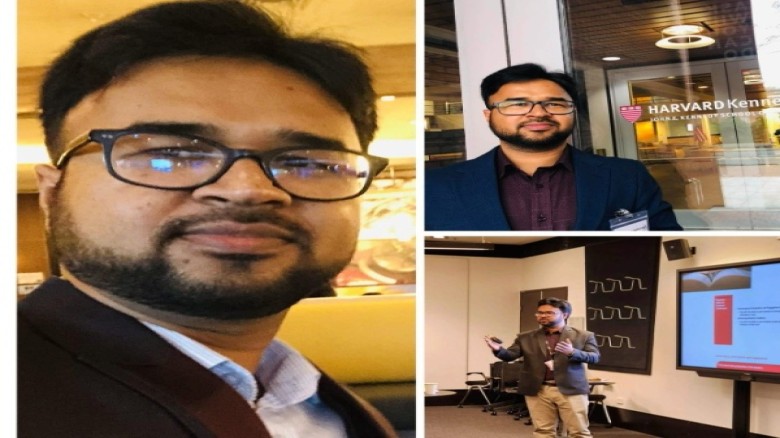 Photo: Collected

From exceptional
academic distinction in Bangladesh to an internationally recognised career in
Australia, Dr. Md Safiullah has established a distinguished profile in finance.
Currently a Senior Lecturer at RMIT University, his research spans sustainable
finance, Islamic banking, and gender diversity, supported by publications in
top-tier international journals, competitive research funding, journal
editorships, and features in prominent media outlets. Combining scholarly
impact with teaching excellence and meaningful public engagement, Dr. Safi represents
a new generation of internationally recognised scholars. Interview by Sakibul
Hasan
You completed your BBA
and MBA at DU, your MSc in the UK, and your PhD in Finance in Australia. How
has this broad international academic journey shaped and strengthened your
career?
Response: Completing academic degrees in three
different countries exposed me to diverse academic systems, broadening my
global perspective, strengthening my research rigour, and shaping me into an
internationally recognized researcher and educator.
You are also a
Certified Practising Accountant (CPA) with CPA Australia and have completed a
FinTech certificate from Harvard University, USA - what motivated you to pursue
these additional professional qualifications alongside your academic career?
Response: Beyond academia, I sought to maintain strong
professional relevance. Obtaining CPA and FinTech credentials has enabled me to
integrate regulatory insight, technological innovation, and real-world
accounting and financial practice into my research, teaching, and engagement.
You achieved 1st place
in your MBA at the University of Dhaka and stood 2nd in the HSC combined merit
list under the Cumilla Education Board-how did these accomplishments shape your
confidence and career trajectory, and what was the key driver behind your
success?
Response: These achievements strengthened my
self-belief and opened early academic opportunities, driven by God’s blessings,
consistent discipline, family support, and a commitment to academic excellence.
How was your PhD
research journey, and how important is publishing in top journals during or after
the PhD?
Response: My PhD thesis focused on risk, efficiency,
and governance in banking, including Islamic banking, using a large
international sample of 28 countries. The PhD journey was exciting and highly
rewarding. All three empirical chapters of my PhD were published in ABDC
A/A-ranked journals prior to the completion of my degree. These papers have
since been widely cited internationally and have also received a Best
Conference Paper Award. Publishing in high-quality journals during the PhD is a
good signal in the job market. It establishes an early research trajectory and
credibility as a potential long-term contributor to the field.
You have published 26
journal articles, including 6 A and 20 A-ranked papers in your areas of
expertise: banking, sustainable finance, and gender diversity. Your work has
appeared in leading journals such as Journal of Corporate Finance, The British
Accounting Review, and Energy Economics. How important is it to continue
publishing in high-quality journals?
Response: Publishing only in ABDC A and A-ranked
journals is a reflection of both the quality and impact of my research. For me,
publishing in such journals is not just a measure of personal achievement-it
also ensures that my work reaches a wider academic and practitioner audience,
influencing scholarship and practice. Continuing to publish in high-quality
journals aligns with my commitment to excellence in academia and provides
opportunities for collaboration, mentorship, and shaping the next generation of
scholars.
You have published
both sole-authored and co-authored papers with 25 co-authors from 12 countries.
How important is such diverse research collaboration, and what challenges does
it present?
Response: Diverse international collaboration enriches
research by bringing multiple perspectives, complementary expertise, and
broader data access, which strengthens both rigor and global relevance.
However, it also requires careful coordination, clear communication, and
alignment of expectations across different academic cultures and time zones.
Your research in
banking, sustainable finance, and gender diversity ranks in the top 5% and 25%
globally on Altmetric and has received nearly 1,600 Google Scholar citations.
Why do you think these topics resonate so strongly at the global level?
Response: These topics resonate globally because they
sit at the intersection of finance, policy, and societal transformation.
Research in these areas naturally attracts wider attention beyond academia,
which is reflected in strong Altmetric performance. The relevance of my work
lies in combining rigorous empirical methods with questions that matter for
real-world decision-making.
You have been invited
to speak on respected media such as ABC Radio National and ABC Radio Perth, and
your research has been featured in SBS News, Yahoo News, The Conversation, The
Australian Today, Hashtag, MFIN and various international media platforms. How
important is it to engage with the media to share your research findings?
Response: Media engagement allows evidence-based
findings to reach policymakers, industry practitioners, and the broader public
in a timely manner. Particularly in areas like banking and sustainable finance,
public understanding can influence informed decision-making and policy debates.
Responsible media engagement also strengthens transparency and accountability
in academia, ensuring that research contributes meaningfully to society beyond
citation metrics.
You also serve as an
Associate Editor for three Q2 journals and as a reviewer for many ABDC
A/A-ranked journals. What common gaps do you observe in research submissions?
Response: Across many submissions, a common gap is the
lack of a clearly articulated research contribution. Authors often present
technically sound analyses but do not convincingly explain how their work
advances theory, policy, or practice. Another frequent issue is weak
positioning within the existing literature, papers sometimes describe prior
studies rather than critically engaging with them to identify a genuine
research gap. Finally, high-quality journals look not only for sophisticated
methods, but also for clarity, originality, and relevance.
You have secured over
$170,000 in research funding. What is your strategy for successful grant
applications?
Response: My research funding often involves
multidisciplinary collaborative projects. My strategy focuses on identifying
timely, relevant research questions that align with funding priorities and
clearly demonstrating the potential impact of the work. I also ensure proposals
are well-structured, concise, and highlight a track record of expertise and
feasibility.
How do you supervise
PhD students to develop independent research identities?
Response: I supervise PhD students by encouraging them
to move beyond simply completing a thesis and instead develop a clear and
original research agenda of their own. I guide them to critically engage with
theory, identify meaningful research gaps, and progressively take intellectual
ownership of their projects through publications and conference presentations.
My aim is that by the end of their PhD, they have a distinct scholarly identity
and the confidence to pursue an independent research trajectory in academia or
industry.
You have more than ten
A/A*-ranked publications in Islamic banking and finance. How do you see Islamic
banking evolving within the global financial system?
Response: Islamic banking is evolving by integrating
Sharia-compliant principles with digital innovation, sustainable finance, and
global risk management, becoming increasingly mainstream in the international
financial system.
Banking in
Bangladesh faces critical challenges. What are your suggestions regarding the
independence of the central bank?
Response: Strengthening the central bank’s
independence is crucial to ensure objective monetary policy, effective
regulation, and financial stability. Clear governance, reduced political interference,
and enhanced accountability mechanisms would help the banking sector address
systemic challenges more effectively.
What are the next big
questions in sustainable finance that researchers should focus on?
Response: Researchers should focus on how sustainable
finance drives real-world environmental and social impact, integrates with
emerging technologies, and influences corporate and investor behavior globally.
What advice would you
give to aspiring Bangladeshi scholars aiming for global academia?
Response: I would suggest focusing on building a
strong research foundation, developing critical thinking, and publishing in
high-quality journals to gain international recognition. Additionally,
cultivate global networks, stay curious, and align your work with issues that
have both local relevance and global impact.
Given your work as a
finance academic at RMIT University in Australia, how can Bangladesh benefit
from your expertise and Australia’s experience?
Response: Bangladesh can draw on Australia’s experience
in regulatory frameworks, digital banking, and sustainable finance, while also
leveraging my research insights on risk, governance, and banking efficiency.
Applying these lessons can strengthen financial stability, innovation, and
inclusive growth in Bangladesh.
Beyond research and
engagement, you are also an award-winning educator and a Fellow of Advance HE,
UK. What is your teaching philosophy, and what feedback from students has been
most meaningful to you?
Response: My teaching philosophy is centered on
creating an engaging, inclusive, and evidence-based learning environment that
encourages critical thinking and real-world application. The most meaningful
feedback I receive from students is when they express that my teaching inspired
them to pursue independent research, challenge assumptions, or apply concepts
confidently in their careers, showing that learning extended beyond the
classroom.
Beyond academia, what
personal values guide your life and work?
Response: Integrity, discipline, and a commitment to
continuous learning guide both my personal and professional life. I also value
empathy and service, striving to make a meaningful impact on the broader
community.