Dhaka

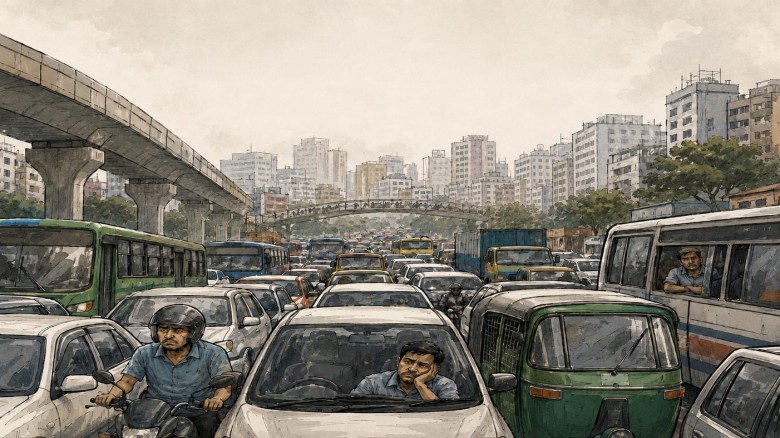 Photo: .

Sakibul Hasan
3.2 million work hours are lost every day due to traffic congestion.
The economy loses an estimated Tk 55,000 crore annually.
Average vehicle speed in Dhaka drops to just 5-7 Km/h during peak hours.
Roads cover only 7-8% of Dhaka’s total land area, compared with the recommended 20-25% for a well-planned city.
“Experts urge integrated planning, modern public transport and stricter traffic management for a lasting solution.”
Traffic
congestion in Bangladesh’s capital is no longer just a daily inconvenience for
city residents; it has become a major challenge to the country’s environment,
economy, and productivity. Millions of daily commuters spend hours struck in
traffic every day, consequently loss valuable work hours, declining
productivity, increase fuel consumption, and significant economic damage. The raising question remains: Will Dhaka
continue to suffer from worsening jam, or will effective measures finally be
taken to address the crisis?
According to
the Bangladesh Institute of Planners (BIP), severe traffic jam in the capital
city of Dhaka the loss of nearly 3.2 million work hours every day. As a result,
the national economy suffers an estimated 550 billion Tk 55,000 crore in annual
losses. Experts say that the impact extends across industrial production,
healthcare, business, education and overall economic growth.
Studies
conducted by the Dhaka Transport Coordination Authority (DTCA) and the World
Bank show that during peak hours, the average speed of vehicles in Dhaka has
dropped to just 5-7 kilometres per hour, barely faster than an average speed
person’s walking speed of around 4-5 kilometers/ hour. In contrast, the city’s
average traffic speed was approximately 21 km/h in 2005, indication that
vehicle speeds have fallen to nearly one-month over the past two decades-a
trend experts describe as deeply alarming.
The World
Bank has also warned that without effective intervention, Dhaka’s average
traffic speed could fall to 4km/h in the future. Prolonged traffic congestion
is also leading to massive fuel wastage and higher carbon emissions, further
worsening the capital’s already critical air pollution.
Transport
experts attribute the city’s chronic congestion to unplanned urbanization, a
growing number of vehicles compared with limited road capacity, the rapid
increase in private cars and motorcycles, an inadequate public transport
system, indiscriminate passenger boarding and alighting, illegal parking,
encroached footpaths and poor coordination among government agencies. Urban
planners note that roads account for only 7-8 percent of Dhaka’s total land
area, whereas a well-planned metropolitan city should have 20-25 percent of its
land dedicated to road infrastructure.
According to
the BRTA Authority, the number of registered motor vehicles in Dhaka continues
to rise every year. However, the road infrastructure and public transport
services have failed to keep pace with the increasing number of private
vehicles, placing enormous pressure on the city’s limited road network.
Voices of
Commuters
The daily
suffering caused by traffic congestion is reflected in the experiences of
ordinary residents.
A pedestrian
said, “A journey that used to take 15 to 20 minutes now often takes more than
an hour. Traffic congestion has become part of everyday life in Dhaka.”
An office
worker said, “Even if leave home on time, I often arrive late at the office
because of traffic congestion. It’s extremely frustrating to lose so much time
every day.”
A bus driver
said, “I spend more time sitting in traffic than actually driving. It reduces
both the number of passengers I can serve and my daily income.”
A patient
going to a hospital said, “Getting stuck in traffic on the way to the hospital
is frightening. Reaching emergency medical care on time becomes very
difficult.”
A student
said, Traffic jam often causes me to miss classes or arrive late for
examinations. It is affecting my education.”
Expert say
traffic jam not only wastes time but also increases transport fuel consumption,
costs, air pollution, and mental stress. Delays in transporting goods raise
business costs, educational institutions, while commuters struggle to reach
offices, and hospitals on time.
They
recommended fully implementing bus route rationalization, modernizing the
public transport system, expanding the metro rail and Bus Rapid Transit (BRT)
networks, introducing smart traffic signals, enforcing traffic laws more strictly,
eliminating illegal parking, and adopting integrated urban planning. They also
stress the need to decentralize employment opportunities and government
services to reduce pressure on the capital city of Dhaka.