Princh Mondal Olif, Bagerhat District Correspondent:
Drug abuse is no longer merely a law-and-order issue. It has become a serious concern for public health, families, workplaces, education and overall social security. While law-enforcement operations are essential to combat the spread of drugs, preventive measures capable of identifying risks at an early stage are equally important. In this context, the introduction of a unified national framework for drug testing in specific sectors and high-risk professions deserves serious consideration.
A significant part of the country's existing approach to drug control remains reactive. Drugs are seized, suspects are arrested and raids are conducted after incidents occur. There is no denying the importance of such measures. However, an effective anti-drug policy should not focus solely on identifying offenders; it should also seek to reduce the risk of drug use and prevent the problem from reaching a critical stage.
This is where drug testing becomes important.
A drug test can detect the presence of specific drugs or intoxicating substances in the human body. However, a positive test result should not automatically be treated as proof of criminal conduct. Scientific interpretation of the result, confirmatory testing, medical assessment and due legal procedures must all be taken into consideration. In other words, drug testing should serve as a scientific tool for identification—not as an instrument of harassment or social humiliation.
Drug testing can be better organised, based on necessity and risk, during recruitment in government and private organisations, for professional drivers, and for positions involving high-risk industrial or other responsibilities. Where appropriate and permitted by policy, testing may also be considered in educational institutions, sports, medical services and forensic procedures.
But an important question remains: where will the test results be kept?
The idea of a separate government-issued drug test certificate, similar in concept to other official documents, may be considered. However, before introducing such a system, strict safeguards must be established to protect the privacy and security of personal health information. If a citizen's drug-test results are improperly disclosed, the consequences could affect employment, education, social reputation and even family life. Therefore, rules regarding data storage, access, disclosure, retention, correction and the right to appeal must be clearly established by law.
Another issue deserves equal attention. Viewing drug-dependent individuals solely as offenders provides only part of the picture. In many cases, addiction requires medical treatment and rehabilitation. Therefore, when a drug test indicates the presence of a substance, appropriate access to treatment, counselling and rehabilitation should be available. Without a proper balance between legal measures and treatment, achieving sustainable progress in drug control will remain difficult.
There can be no compromise over the quality of drug testing. Poor-quality testing kits, improper sample collection, inadequate sample preservation or insufficient laboratory standards can undermine the reliability of test results. Therefore, authorised laboratories, trained personnel, standardised testing equipment and confirmatory testing where necessary should be made integral parts of the system.
Rather than subjecting every citizen to testing in the same manner, a risk-based framework may be more reasonable. In professions and responsibilities where drug use could seriously endanger the individual or the lives and safety of others, regular or scheduled testing may be more justified. At the same time, the purpose of testing, its legal basis and the rights of the individuals concerned must be clearly defined.
A National Drug Testing Policy should therefore be formulated. It should clearly determine where tests will be conducted, who will conduct them, what types of samples will be collected, which substances will be screened, how results will be confirmed, how long the information will be retained, who will have access to it and what remedies will be available in cases of disputed or erroneous results.
The fight against drugs cannot remain dependent solely on law-enforcement operations. What is needed is a coordinated approach involving prevention, early detection, treatment, rehabilitation and public awareness. Drug testing can be one component of such an integrated strategy.
At the same time, it must be remembered that the purpose of drug testing should not be to increase surveillance over citizens; rather, it should be to reduce risks. It should not be used to humiliate individuals but, where necessary, to facilitate access to treatment. It should not become a means of unjustly denying opportunities; instead, it must ensure scientific accuracy, fairness and due process.
A Clear Appeal to the Government
Given the growing concern over drug abuse, the government should take immediate steps to formulate a comprehensive and long-term National Drug Testing Policy. The Ministries of Health and Family Welfare, Home Affairs, Education and other relevant authorities, along with the Department of Narcotics Control, transport authorities and medical experts, could work together to develop an effective framework.
Our clear appeal to the government is this: an integrated drug-testing policy should first be developed and implemented, where appropriate, for recruitment in government and private organisations, professional drivers, high-risk responsibilities and other relevant sectors. At the same time, the feasibility of introducing a government-issued drug test certificate and a secure system for storing and managing test results should be carefully examined.
However, any such system must be accompanied by strong safeguards for citizens' rights and privacy. Individuals should have access to re-testing in cases of disputed or questionable results, independent confirmatory testing and an appropriate appeal mechanism. Test results must not be disclosed without lawful authorisation, and a person should not face unjust social or professional discrimination solely on the basis of an unconfirmed test result.
The government should also expand treatment, counselling and rehabilitation services for people struggling with drug dependence. The success of drug control should not be measured only by how many people are identified or arrested; it should also be measured by how many people are helped to return to healthy, drug-free lives.
Therefore, to make the fight against drugs more effective and forward-looking, the government should move towards a practical framework integrating scientific drug testing, a national policy, secure information management, the right to re-testing and appeal, and treatment and rehabilitation services.
When the drug menace can affect individuals, families, communities and public safety, preventive measures can no longer be ignored. The time has come to move beyond enforcement alone and establish an integrated system of early detection, prevention, treatment and rehabilitation. Ensuring citizens' rights and privacy, the government should take a timely policy decision on introducing an effective drug-testing system and, where appropriate, a government-issued drug test certificate. That is the need of the hour.
News Published By:
Bangladesh Diary

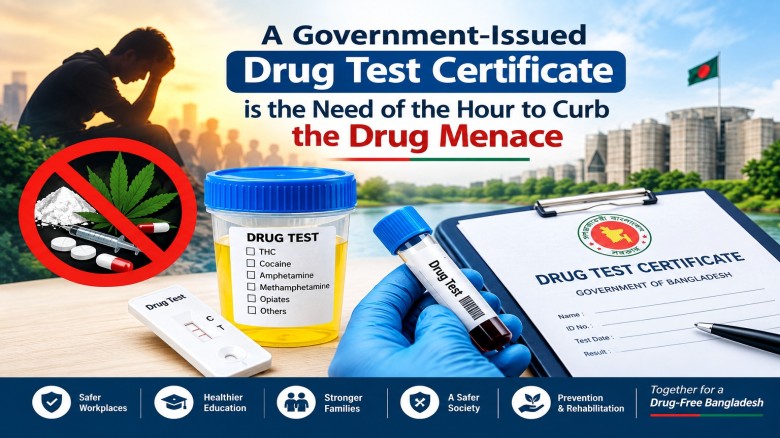 Photo: .