Dhaka

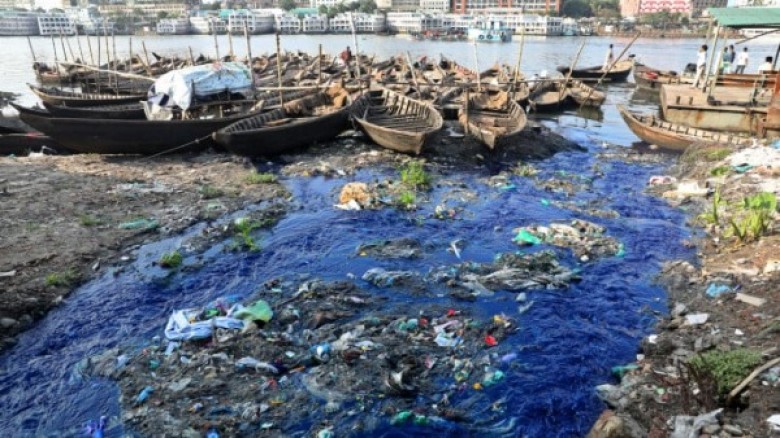 Photo: .

Sakibul Hasan
For years,
laws have been legislated, projects launched and removal campaigns carried out
to protect the rivers surrounding Dhaka. Yet contamination keeps increasing and
illegal occupation continues. The question, therefore, is not simply whether
plans exist rivers but whether those plans are actually being implemented.
Observing from the banks of Dhaka's rivers, the first thing that catches the
eye is often not the river itself but the indication of pollution.
In some
places, the water has turned dark-coloured. in others, industrial waste has
altered original colour. Discard plastic and domestic waste gather along
riverbanks, while polluted water flows directly into the rivers through narrow
drains. The Buriganga, Balu, Turag and
Shitalakhya once played a crucial role in Dhaka's economy and everyday life.
Today, significant stretches of these rivers have been reduced to little more
than waterways for transporting waste.
In August
2026, the government said a total of 224 waste-discharge points had been
identified along the Buriganga and Turag river. These, 166 are situated along
the Buriganga and 58 the Turag.
The sources are not limited to private
industrial facilities. Government agencies, including Dhaka WASA, city
corporation and other local government bodies, have also been connected to some
of the discharge points. The government has said it plant to identify the
Institutions accountable and prevent illegal dumping.
A government
survey found dissolved oxygen levels in the Buriganga ranging from 1.70 to 2.68
milligrams per litre. The survey noted that a healthy river environment
generally needs a DO level of around 5 milligrams per litre. In some sections,
therefore, oxygen levels are less than half of what is considered necessary for
a healthy aquatic environment.
A
peer-reviewed study published in June 2026 points in even more alarming view of
the Turag river. Researcher collected water sample from 20 sampling sites
during the dry season. The study found dissolved oxygen levels falling to
reaching a minimum of 0.9 milligrams per litre.
Waste goes
into the river-but where does responsibility go? This maybe the most difficult
question in Dhaka's river pollution crisis. In a factory releases untreated
waste into a river, who is accountable for stopping it?
In Bangladesh,
this responsibilitie do not rest with a single institution. The department of
environment, Dhaka WASA, Bangladesh Inland Water Transport Authority, National
River Conservation Commission and city Corporations, among others, are involved
in river protection control. but when responsibilities are divided among
multiple agencies, accountability can become unclear.
One agency
may be responsible for pollution control, another for waste water management,
while another is tasked with protecting waterways. In some areas, boundary
demarcation is in progress, in others, removal campaigns are carried out. But
if polluted water continues to enter the rivers and encroachment comes back after
eviction drives, question remain about the sustainability of those
interventions.
Court orders
exist but how much has been implemented?
In 2009, the
high court issued important directives to protect Dhaka's four major rivers-
the Buriganga, Balu, Turag and Shitalakhya including measures to mark their
boundaries and stop contamination and encouragement. Nearly to decades have
passed.
Various
initiatives have been undertaken, including the installation of boundary
pillars, construction of waterways along riverbanks and eviction of illegal
structures. Yet a 2026 report found that many of the prescribed measures for
protecting the four rivers remain incomplete, event 17 years after the courts'
directives.
This reveals
one of the fundamental problems of river conservation in Bangladesh. Absence of
legislation and directives may be a problem but the bigger obstacle appears to
the lack of consistent implementation. A river cannot be saved through a single
eviction drive. Protecting it requires simultaneously stopping contamination at
its source, permanently securing river boundaries and ensuring continuous
monitoring.
Can dredging alone save the rivers?
Excavating
may be necessary to remove accumulated silt and contaminated material from
riverbeds. But removing sediment itself is not a permanent solution. If
industrial waste, sewage and solid garbage continue to enter the rivers, the
same riverbeds will need to be cleaned time and again. It is like cleaning a
house while leaving the door open for new waste to water every day.
In 2026, the
government announced plans to increase the navigability of the Buriganga
through excavating, alongside initiatives for online monitoring of Effluent
Treatment Plants (ETPs) at industrial facilities. Such measures are essential
because cleaning the river is only one part of the solution. Preventing new
contamination from entering it is equally, if not more, important.
The damage extends beyond the rivers
Rivers are
often treated simply as buddies of water. but an urban river is deeply
connected to the economy, environment and everyday lives of the people around
it. River-dependent the source of income include transportation, agriculture,
fishing and small businesses. Rivers and wetlands are also closely connected to
the city's drainage system and its eligibility to manage rainwater.
When rivers
are narrowed by encouragement, natural water flow is blocked. When canals and
waterways are filled, extra rainwater has fewer routes through which it can
drain. Simultaneously, people living near contaminated rivers face growing
environmental risks. Protecting rivers, therefore, is not a luxury for
environmentalists. It is an important part of public health, flood and
waterlogging management, source of income and long-term urban planning.
Why has the situation not changed
after all these years?
This maybe
is the main part of the problems lies. The issue is not necessarily a lack of
initiatives to protect Dhaka's rivers. Rather, it is whether those initiatives
are adequately organized, consistent and responsible. On one hand contamination
control drives are being conducted. On the other, new source of pollution to
appear. River land is being recovered but encroach come back in some areas.
Projects are being undertaken to restore rivers. On the other hand, untreated
sewage continues to flow into them.
in August
2026, the government announced plans develop a coordinated strategy to control
contamination in the Buriganga and Turag. The government has also emphasised
the need for stronger and more organized action against river pollution.
Is a solution possible?
The answer
would be yes but the solution cannot be limited to conducting eviction drives
along riverbanks.
First, every source of direct garbage
discharge into the rivers must be identified and permanently shut down
immediately.
Second, monitoring industrial ETPs cannot
stop at verifying whether a treatment plan has been installed. Authorities must
make sure that the plants are actually operating on a regular basis and that
their performance is being monitored.
Third, Dhaka's waste water management
system need fundamental reform. If untreated sewage continues to flow into the
rivers, no river cleaning campaign can succeed in the long run.
Fourth, river border and eviction of
illegal structures should not be treated as one time campaigns. They need to be
placed under a permanent system.
Fifth, the accountabilities of different
government agencies must be clearly identified. The public should know which
agency is responsible for a particular pollution source and how long it has to
take action.
The crisis
facing Dhaka's river has developed over decades. It is not possible to solve
overnight. But the longer the problem continues, the more expensive and
difficult the solution becomes.
Ab illegal
structure on a riverbank may visible to be a small problem. A single drain
discharging garbage into a river may seem like an isolated failure of urban
management. But thousands of such failures, accumulating over time can, can
push me an entire river towards environmental collapse. Therefore, saving
Dhaka's rivers need more than another project announcement.
It requires
identifying who is contaminating the rivers, clearly identifying who is
accountable, ensuring responsibility when agencies fail to act and regularly
measuring whether the health of the river is actually improving. Because a
river is more than a flow of water. It's a part of a city's environmental
memory, economy and future. If Dhaka
fails to save its rivers now, there may come a day when there are still river
restoration projects, boundary maps and court orders- but no river left worth
saving.